
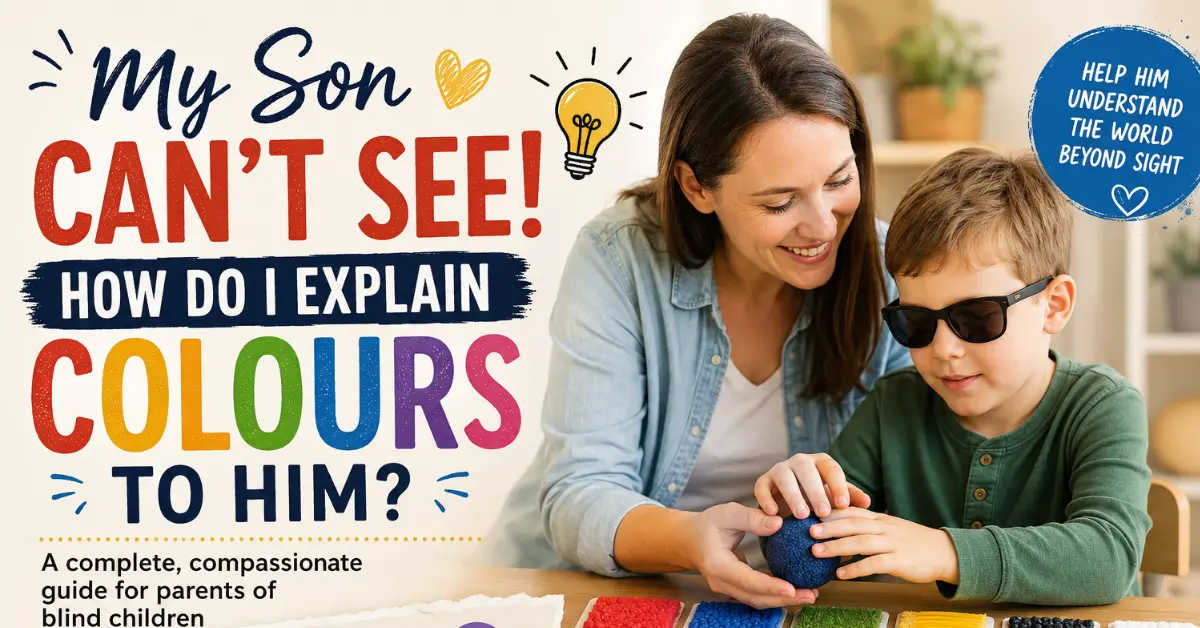
A complete, compassionate guide for parents of blind children
You stare at the crayon box. Your son reaches out, runs his fingers along the waxy sticks — curious, patient, trusting. Then he asks: “What colour is this one?”
And for a moment, you don’t know what to say.
You are not alone in this moment. Thousands of parents across the world have typed the exact same words into a search bar: “My son can’t see — how do I explain colours to him?” And it is a beautiful question, because it shows how much you want your child to feel connected to the world around him.
Here is the truth: blind children can absolutely learn about colours. Not through their eyes — but through their feelings, their senses, their memories, and the language people share every day. This guide will show you exactly how.
Can a Blind Child Really Understand Colours?
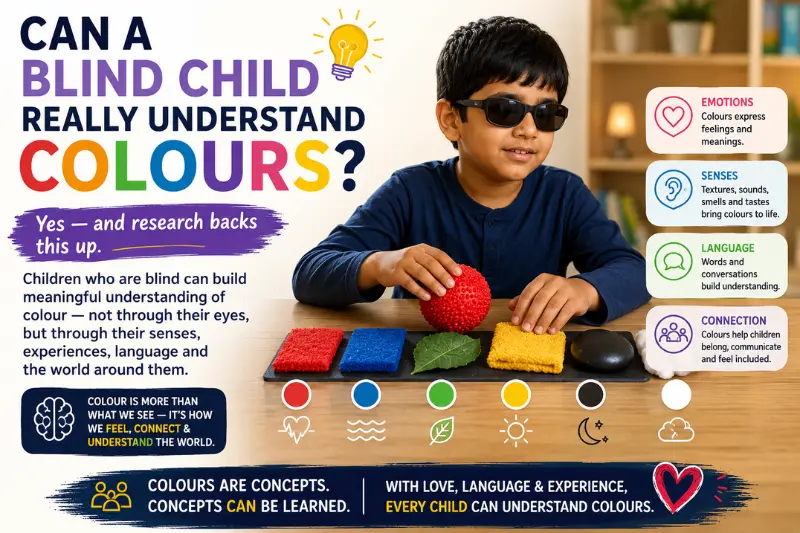
Yes — and research backs this up.
Studies in developmental psychology show that children who are blind from birth can still build meaningful conceptual frameworks for colour. They may not perceive colour visually, but they understand colour as a system of meaning, emotion, and cultural reference.
Think about how you understand “freedom” or “fairness.” You have never touched either of them. Yet you understand them deeply because of stories, experiences, and emotions. Colour works the same way for a blind child.
What your son can learn about colour:
- What colour each common object is (grass is green, fire trucks are red)
- Emotional associations with colour (red = energy, blue = calm)
- Cultural meanings (white at weddings, black at funerals)
- How colour functions as information and social language
- Colour combinations — what matches and what clashes
Why Teaching Colours to a Blind Child Matters More Than You Think
Many parents avoid the topic of colour, worrying it might upset their child. But child development experts agree: avoiding colour creates confusion, not protection.
Colour is woven into everyday language and social life:
- “I’m feeling blue today.”
- “That was a golden opportunity.”
- “She gave him a green light.”
- “He was caught red-handed.”
- “That’s a black-tie event.”
Your son will hear colour references in school, in books, in conversations, in music, and in films. Understanding what those references mean helps him feel included — not left out.
Beyond language, colours also carry practical social importance: choosing clothing that matches, understanding traffic signals, and knowing the colour of his favourite team’s jersey are all part of everyday life.
The Golden Rule: Never Be Afraid to Talk About Colours
This is the first and most important step. Say the word. Use it naturally.
Many parents tiptoe around colour as if naming it will cause pain. But for a child who has never seen colour — and especially for one who once could — colour is simply a concept to be curious about, not a wound.
- Say: “Here’s your red cup.”
- Say: “These are your blue jeans.”
- Say: “The sky is grey today — it might rain.”
Naming colours in daily conversation builds a natural, pressure-free vocabulary over time. Your child will absorb these associations the same way he learns any other word: through repetition, context, and experience.
How to Explain Individual Colours Through the Senses
This is where most guides fall short. Describing colours through sensory, emotional, and real-world anchors makes them truly meaningful. Here is how to explain each major colour in a way your son can actually feel and remember.
🔴 How to Explain Red
- Temperature: Red is hot. Think of the heat from a radiator or the warmth of the sun on your face.
- Touch: Red is intense — like the sting of a nettle, or the rough bark of a tree on a warm day.
- Taste: Red tastes like a ripe strawberry, a hot chilli pepper, or tomato sauce.
- Sound: Red is loud. It is a drum beat, an alarm, a fire engine’s siren.
- Emotion: Red is urgent, exciting, passionate. It signals danger and draws attention.
- In the world: Roses, fire trucks, stop signs, apples, ketchup.
🔵 How to Explain Blue
- Temperature: Blue is cool. Think of cold water from a tap, or a breeze off the sea.
- Touch: Blue is smooth — like a calm lake surface or a cool glass of water on a warm day.
- Sound: Blue is quiet and low. Think of a cello, a slow saxophone, or waves on a shore.
- Emotion: Blue is calm and thoughtful — but also sometimes sad (“feeling blue”).
- In the world: The sky on a clear day, the ocean, blueberries, denim jeans.
🟢 How to Explain Green
- Temperature: Green is neutral — neither hot nor cold. It is the temperature of a shaded garden.
- Touch: Green is alive — the texture of fresh grass under bare feet, leaves between fingers.
- Smell: Green smells fresh, like a lawn just after rain or mint leaves crushed in your palm.
- Emotion: Green means go. It means grow, live, rest. It is hopeful and steady.
- In the world: Grass, trees, leaves, peas, cucumbers, frogs.
🟡 How to Explain Yellow
- Temperature: Yellow is warm — like sunshine landing on your arms, or a cosy lamp.
- Taste: Yellow is sweet and bright — like lemon, banana, or sweetcorn.
- Sound: Yellow is cheerful — like a flute, a child’s laugh, or birds in the morning.
- Emotion: Yellow is happy and energetic. It is the colour of optimism.
- In the world: Sunflowers, bananas, lemons, school buses, sunshine.
⚫ How to Explain Black
- Touch: Black is smooth, sleek, and strong — like polished leather shoes.
- Sound: Black is silence. It is the quiet after everyone has gone to sleep.
- Temperature: Black absorbs heat — a black car in the sun gets very hot.
- Emotion: Black is serious, formal, and powerful. It is also the colour of mystery.
- In the world: Night sky, coal, ink, piano keys, penguins.
⚪ How to Explain White
- Touch: White is soft and clean — like fresh snow, cool cotton sheets, or flour.
- Temperature: White reflects heat. Think of a white t-shirt in summer keeping you cool.
- Sound: White is quiet — like the hushed silence after a snowfall.
- Emotion: White is pure, open, and peaceful. It is the colour of a fresh start.
- In the world: Clouds, snow, milk, paper, wedding dresses, polar bears.
Practical Activities to Teach Colours at Home
The best learning happens in real life, not in formal lessons. Here are activities specifically designed for blind children that bring colours to life.
1. Build a Sensory Colour Box
Dedicate a small box or bag to each colour. Fill it with items that represent that colour through texture, smell, sound, and taste.
Red box might include: a smooth pebble (for intensity), a small sachet of chilli powder (smell), a piece of velvet fabric, a toy fire engine bell.
Blue box might include: a smooth, cool glass marble, a small piece of silk, a shell from the beach, a recording of ocean waves.
Let your son explore each box. Say the colour name as he handles each object. Over time, the colour becomes a rich, multi-layered concept — not just a label.
2. Colour Talk During Daily Routines
Use everyday moments as teaching opportunities — without making it feel like a lesson.
- At meals: “Your orange juice is, of course, orange — same colour as an orange!”
- Getting dressed: “These are your navy blue trousers. Navy blue is a very deep, serious shade of blue — like the deep ocean.”
- On walks: “The leaves we just touched — those are green in spring. In autumn, they turn orange, red, and brown.”
- In the kitchen: “Tomatoes start green and turn red as they ripen — red means they’re ready.”
3. Use Music and Sound Associations
Music is one of the most powerful tools for a blind child. Researchers have found that many people — sighted and blind alike — associate colours with sounds and musical tones.
- Red: Drums, trumpets, fast-paced music
- Blue: Slow cello, piano, ocean sounds
- Yellow: Flute, birdsong, upbeat melodies
- Green: Acoustic guitar, rustling leaves, nature sounds
- Black: Silence, bass notes, deep piano chords
Create a short playlist for each colour. When you introduce a colour, play its “sound” alongside the sensory box experience.
4. Colour Storytelling
Read or tell stories that feature colour prominently — then pause to explain each colour as it comes up.
For example, when reading a story where a character wears a red cloak, stop and say: “Red is the colour of urgency and courage — it stands out, like an alarm. That is why the character wears it.”
Books like The Day the Crayons Quit are specifically available in braille print editions and make wonderful starting points.
5. The Colour Guessing Game
Make it playful. Give sensory clues and ask your son to guess the colour.
“I am thinking of a colour that feels like cold water, sounds like a quiet saxophone, and covers the sky on a clear day. What colour am I?” (Blue!)
This reinforces associations while making learning feel like a game — no pressure, just fun.
Technology Tools That Can Help
This is a gap most competitor articles completely miss. Modern technology gives blind children and adults remarkable access to colour information.
Colour-Identifying Apps (2025)
- Be My Eyes — connects your child with a sighted volunteer via video call who can describe colours and visual details in real time.
- Seeing AI (Microsoft) — uses the phone camera to identify colours of objects, clothing, and surfaces and reads them aloud.
- ColorSay — a simple app that identifies the colour of whatever the camera points at and speaks it aloud.
- Envision AI — describes entire scenes, including colours, using AI-powered image recognition.
Smart Home Devices
Voice assistants like Amazon Alexa or Google Assistant can answer questions like “What colour is a sunflower?” instantly — giving your child an independent way to explore colour without always needing a parent nearby.
Tactile Clothing Labels
As your son grows, help him maintain his independence by labelling clothing with tactile tags — small textured labels that indicate colour or outfit matching. The American Printing House for the Blind sells Tactile Clothing Tape kits specifically for this purpose.
Teach the Emotional and Cultural Language of Colour
One of the most overlooked aspects of colour education is its social and cultural dimension. Colours carry meaning that goes far beyond physical appearance — and this meaning is what your son will encounter most often in books, conversations, and films.
Colour Emotions — A Quick Reference
- Red: Passion, danger, urgency, love, energy
- Blue: Calm, sadness, trust, loyalty, depth
- Yellow: Happiness, optimism, warmth, caution
- Green: Growth, nature, envy, health, hope
- Black: Power, mystery, elegance, grief
- White: Purity, peace, cleanliness, new beginnings
- Purple: Royalty, creativity, wisdom, spirituality
- Orange: Enthusiasm, warmth, adventure, harvest
Colour in Everyday Language
Teach your son these common phrases so he always understands what people mean:
- “Feeling blue” = feeling sad
- “Seeing red” = feeling very angry
- “Green with envy” = jealous
- “Caught red-handed” = caught doing something wrong
- “Golden opportunity” = a very valuable chance
- “Black sheep” = the odd one out in a family
- “Grey area” = something unclear or uncertain
- “In the pink” = in excellent health
Common Mistakes Parents Should Avoid
You are doing your best. But here are a few well-meaning habits that can actually slow down your child’s understanding of colour.
Mistake 1: Saying “You Can’t Understand Colours”
Your child can understand colours — just differently. Never shut down the conversation. Curiosity about colour is healthy and normal. Welcome every question with enthusiasm.
Mistake 2: Overloading With Too Many Colours at Once
Start with the most common colours: red, blue, green, yellow, black, and white. Build from there. Introducing every shade of purple on day one creates confusion, not understanding.
Mistake 3: Making It a Test
“What colour is this?” as a quiz question creates anxiety. Let colour learning be casual, woven into daily life. Your son should absorb colour knowledge the way he learns any other vocabulary — naturally, over time.
Mistake 4: Avoiding Colours That “Don’t Apply”
Some parents avoid mentioning colours of visual things like sunsets or rainbows, thinking it is pointless. In fact, these are some of the richest colour conversations you can have. A rainbow is not just visual — it is cultural, emotional, and symbolic. Talk about it freely.
Mistake 5: Forgetting to Update as He Grows
A five-year-old needs simple sensory associations. A twelve-year-old is ready for subtleties — that apples can be red or green, that the sky changes colour throughout the day, that colours look different in different lighting. Revisit colour education as your child grows.
What Blind Adults Say About Colour
Sometimes the most powerful guidance comes from those who have lived the experience.
Deborah Kent, a blind author who has written extensively about blindness and childhood, writes that while she has never seen colours, she has a rich and confident understanding of them. She knows crows are black, leaves are green, and that hair can be blonde, brown, red, or any colour a person chooses to dye it.
Tommy Edison, a blind comedian and YouTuber blind since birth, has spoken openly about how he understands colours through the descriptions people give him — and how he finds the challenge of describing colour to others genuinely fascinating, not distressing.
The consistent message from blind adults: colours are concepts, and concepts can be learned. What matters is that the people around them talked about colour freely, without embarrassment, and with creativity.
When to Start — and How to Keep Going
Start as early as you can. There is no wrong age to begin introducing colour vocabulary. Babies and toddlers absorb language effortlessly — name colours as you name everything else in their world.
For older children who are newly blind, colour may carry an emotional dimension — the memory of what colour looked like. Be sensitive to this, and follow your child’s lead. Some children want to talk about those memories. Others prefer to focus on building new associations. Both are valid.
The key is consistency. Colour is not a one-time lesson. It is a running thread through daily life — in every meal, every outfit, every walk, every story.
Frequently Asked Questions
Can a child who has been blind since birth imagine colours?
Research shows that congenitally blind children — those blind from birth — can build strong conceptual understanding of colour through language, sensory association, and emotion. They do not “imagine” colour visually in the way sighted people do, but they develop their own internal framework for what colour means.
At what age should I start explaining colours?
As early as possible. Toddlers absorb colour vocabulary easily when it is introduced naturally. There is no need to wait for a formal lesson — just start naming colours in everyday conversation from day one.
What is the easiest colour to start with?
Red is often recommended first because it has strong, clear sensory associations: heat, urgency, loudness, and distinctive tastes (strawberry, chilli). It is also one of the most common colours in everyday objects.
Should I explain colour differently if my son once had sight?
Yes. A child who had partial or full vision before losing it may have visual memories of colour. These memories are valuable — refer to them when you can. “Do you remember what the red roses in our garden looked like?” This connects new learning to existing memory and can be deeply comforting.
Can blind children enjoy colourful books and art?
Absolutely. Many books are available in combined print-braille editions. Tactile picture books — where illustrations are rendered in raised textures — allow blind children to explore images through touch. Organisations like the American Printing House for the Blind and the Royal National Institute of Blind People (RNIB) offer excellent resources.
Is it upsetting for a blind child to learn about colour?
Generally, no — especially if colour is introduced naturally from an early age. Children who have never seen colour do not grieve its absence the way adults might imagine. Curiosity and engagement are far more common responses than sadness.
How do I explain colour to a child who asks “But what does red look like?”
Be honest and creative. You might say: “I can’t put the picture in your mind the way I see it — but I can tell you what red feels like. It feels hot and fast and loud. It feels like excitement and danger at the same time. Does that help?” Most children find this satisfying — and fascinating.
Final Thoughts
You reached for the crayon box. You wondered what to say. That moment of pause — that was love.
The answer is not one perfect explanation. It is a thousand small ones: “Your jumper is green, like the grass.” “That music sounds blue, doesn’t it?” “Strawberries are red — same red as your favourite lolly.”
Colour, for your son, will not be something he sees. It will be something he knows — through his hands, his nose, his ears, his feelings, and the words you give him.
And that knowledge, built slowly and lovingly over time, will be just as real as any colour ever seen.
Sources & Further Reading
National Braille Press — Great Expectations Programme: nbp.org
American Printing House for the Blind: aph.org
Royal National Institute of Blind People: rnib.org.uk
Microsoft Seeing AI App: seeingeye.ai
Be My Eyes: bemyeyes.com
