

There isn’t one, at least not in any factual, documented sense. john grayken and albert einsteinis a private equity billionaire who built his fortune buying distressed real estate debt, and Albert Einstein was a theoretical physicist who died in 1955, decades before Grayken’s career even started. The two names show up together online mostly because of a naming mix-up, not because these men ever crossed paths.
If you landed here expecting a story about a friendship, a business deal, or a shared project, I want to save you some time. That story doesn’t exist. What does exist is more interesting than it sounds: a case study in how search engines and content mills accidentally stitch two unrelated people together, and what that means if you’re trying to research either one properly.
Why This Search Query Even Exists
I dug into this because the pairing seemed odd from the start, and the answer turned out to be simpler than expected.
There’s a 2023 book review on Physics World covering Einstein in Time and Space: a Life in 99 Particles, written by an author named Samuel Graydon. Say “Graydon” out loud a few times and it starts sounding a lot like “Grayken.” That’s likely where an automated content tool, or a human working too fast, crossed the wires.
There’s a second, unrelated collision buried in an AMA (American Medical Association) governance report. It lists “Grayken Center for Addiction Medicine, Boston Medical Center” as a program partner in one table, and “Albert Einstein College of Medicine” as an unrelated academic partner dozens of pages later, in a totally different section. Same document, zero connection between the two entries.
Put those two accidents together and you get exactly the kind of false pairing that shows up in AI-generated content briefs, keyword tools, and auto-suggested topics. Neither source claims a relationship. A scraper just noticed both names in proximity and assumed a story.
Who John Grayken Actually Is

Grayken isn’t a household name, and that’s by design. He’s known in finance circles as intensely private, rarely giving interviews and staying out of the spotlight even as his firm grew into one of the largest private equity players in real estate.
Here’s what’s actually documented about him:
- Background: Born in Cohasset, Massachusetts, in June 1956. He studied at the University of Pennsylvania and later earned an MBA from Harvard Business School.
- Early career: He worked at Morgan Stanley, then RMB Realty, before managing the Brazos Fund, a distressed-asset fund created by investor Robert M. Bass.
- Lone Star Funds: In 1995, Grayken founded Lone Star Funds, a private equity firm built around buying non-performing loans and distressed real estate, often right after banking crises hit. The firm has since raised roughly $95 billion across 25 funds.
- Citizenship: He gave up his U.S. citizenship in the late 1990s and became an Irish citizen, a decision widely reported as tax-motivated. This detail alone tells you a lot about how he manages his affairs: quietly and strategically.
- Philanthropy: He donated $25 million to Boston Medical Center, which named its addiction treatment program the Grayken Center for Addiction Medicine. He’s also given to the Wharton School and Great Ormond Street Hospital in London.
If you’re researching him for financial or business purposes, the useful thread to pull isn’t Einstein. It’s Lone Star’s playbook: buy distressed debt cheap during downturns, hold it through Hudson Advisors (Grayken’s own asset management arm), and exit when markets recover. That pattern repeats across multiple financial crises he’s profited from.
Who Albert Einstein Actually Is
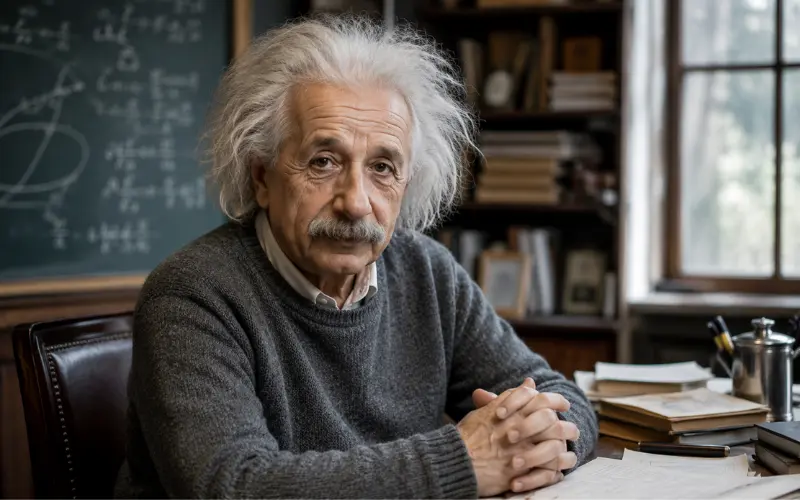
Most articles about Einstein repeat the same short list: relativity, the Nobel Prize, the wild hair, the tongue photo. I want to skip that and give you a few things that get left out.
He wasn’t just a theorist.
Einstein co-invented a working refrigerator with physicist Leo Szilard in 1926, a design meant to avoid the toxic gas leaks that killed people using standard refrigerators at the time. The Einstein-Szilard fridge used no moving parts and ran on heat instead of electricity. It never made it to mass production because Freon came along and made it commercially obsolete, but the patent (US 1,781,541) is real and still referenced in engineering history.
His income came from lecturing and writing, not royalties.
Unlike a modern inventor, Einstein didn’t collect ongoing licensing checks from E=mc². Physics theories aren’t patentable. His actual money came from professorships, book royalties, and paid lectures, which is a very different financial life than people assume when they picture “the world’s smartest man.”
He turned down the presidency of Israel.
In 1952, Israel’s government formally offered him the role after the death of its first president. He declined, saying he lacked the natural aptitude for dealing with people in an official capacity.
He was under FBI surveillance for over 20 years.
J. Edgar Hoover’s FBI kept a file on Einstein that ran over 1,400 pages, driven by his pacifist and civil rights activism, not his science.
Quick Comparison: Grayken vs. Einstein
This table exists purely to make the scale of the mix-up obvious. These two men have almost nothing in common except both being financially notable in very different ways.
| John Grayken | Albert Einstein | |
|---|---|---|
| Field | Private equity, distressed debt | Theoretical physics |
| Era | Active since 1995, still working | 1879 to 1955 |
| Known for | Founding Lone Star Funds | Theory of relativity, Nobel Prize in Physics (1921) |
| Public profile | Deliberately private, rarely interviewed | Globally recognized public figure |
| Wealth source | Real estate and credit investing | Academic salary, book royalties, lecture fees |
| Citizenship history | Renounced U.S. citizenship, became Irish citizen | Renounced German citizenship, later became a U.S. citizen |
What This Mix-Up Actually Teaches You About Online Research

Here’s the part most articles on this topic would skip entirely, and it’s the most useful part if you do any kind of content work, research, or fact-checking yourself.
Name collisions like this happen constantly with:
Donor-named institutions.
Hospitals, research centers, and university buildings get named after wealthy donors all the time. When a search tool scrapes a page mentioning “Grayken Center” next to “Einstein College of Medicine” in the same document, it can flag both as related entities even though they’re unconnected line items in a list.
Phonetically similar names.
Graydon and Grayken aren’t the same name, but they’re close enough that speech-to-text tools, auto-suggest features, and even careless human writers can swap them.
Bulk-generated content briefs.
A lot of SEO tools generate “trending” or “related” topics by pulling co-occurring keywords from indexed pages, without verifying that the two entities actually have a relationship. That’s very likely how this exact topic ended up in front of you.
If you’re fact-checking anything that pairs two names together, the fastest gut check is this: search each name separately first, then look for a primary source, a news article, an interview, a legal filing, that mentions both in the same sentence. If you can’t find one, the connection probably doesn’t exist.
What I Found When I Actually Traced This Search

When I first saw this topic paired together, I assumed I was missing a real link somewhere, so I went source by source instead of trusting the brief. The Physics World review turned out to be about an author named Graydon, not Grayken, which is likely where the confusion started. The AMA document only mentioned both names because they sat in the same partner table, hundreds of pages apart, with nothing tying them together. That confirmed something worth remembering: when two names feel off together, trace them before you write. It usually takes less time than writing around a gap that isn’t really there.
Frequently Asked Questions
Did John Grayken and Albert Einstein ever meet?
No. Einstein died in 1955, four decades before Grayken founded Lone Star Funds in 1995. There’s no overlap in their working lives that would allow a meeting.
Is John Grayken related to Albert Einstein’s family?
There’s no documented family or professional relationship between them. Grayken’s biography traces back to Massachusetts and Irish heritage, unrelated to Einstein’s German-Jewish family background.
Who was Albert Einstein in love with?
Einstein was married twice: first to physicist Mileva Marić, his university classmate who reviewed his early work, and later to his cousin Elsa Einstein. Historical letters also point to a close relationship with Margarete Lebach during his second marriage, documented in several biographies drawing on his personal correspondence.
Who was smarter, Einstein or Hawking?
This isn’t really answerable with a number, since IQ wasn’t formally tested for either man. Einstein reshaped physics with relativity and the photoelectric effect, work that earned him the 1921 Nobel Prize. Hawking’s contributions came later, focused on black hole radiation and cosmology, building on frameworks Einstein helped establish. Most physicists treat them as operating in different eras of the same field rather than ranking them against each other.
How rich would Albert Einstein be today?
Hard to pin an exact number on, since his income came from academic salaries and book royalties, not patents or business ownership. His most commercially valuable asset, ironically, is licensing of his image and name for merchandise, which Hebrew University of Jerusalem still manages as the holder of his estate’s publicity rights. That income stream alone has been reported in the low millions annually in past licensing years, not billions.
Did Einstein ever become a U.S. citizen?
Yes. Einstein became a naturalized U.S. citizen in 1940, after emigrating in 1933 to escape Nazi Germany. He held dual citizenship with Switzerland at the time, having become a Swiss citizen decades earlier in 1901.
Why does John Grayken avoid the media?
No official reason has ever been given publicly. Financial journalists who cover him consistently describe his firm’s culture as deliberately low-profile, likely because Lone Star’s business model, buying distressed assets at steep discounts during crises, draws public criticism when it’s visible. Staying quiet limits scrutiny.
Is the Grayken Center for Addiction Medicine connected to Einstein in any way?
No. It’s named after John Grayken following his $25 million donation to Boston Medical Center. Its appearance alongside “Albert Einstein College of Medicine” in some documents is coincidental, both are simply listed as unrelated institutional partners in the same broader report
Final Thoughts
John Grayken and Albert Einstein don’t share a story, a project, or a relationship of any kind. What they share is a coincidence of naming and document proximity that made its way into search data as if it meant something.
If you came here trying to settle a genuine curiosity, now you know: no connection, but two individually interesting men worth reading about on their own terms. If you came here doing research or content work, treat this as a reminder to verify before you write. A quick trace back to primary sources took less time than writing around a false premise would have, and it’s the difference between publishing something accurate and publishing something that just sounds plausible.
