

Do you know How can I get a new gas pipeline connection easily? If you have been Googling this at midnight because your kitchen still runs on cylinders while your neighbor’s meter is already ticking, you are not alone. This question has become one of the most searched utility topics in India this year, and for good reason.
Direct Answer: To get a new gas pipeline connection, find the authorized City Gas Distribution (CGD) company for your area, check pipeline availability at your address online, submit your application with ID and address proof, pay the refundable security deposit, and wait for a technician to inspect and install the meter. The process usually takes 7 to 30 days once your building already has pipeline access, and applying online with clean scanned documents is the single fastest way to cut down wait time.
That’s the short version. The rest of this guide covers what actually slows people down, what it really costs city by city, and one regulatory change from earlier this year that most homeowners still don’t know about.
My Personal Experience
When I got my own PNG connection sorted last year, the actual installation took less than a week. The part that ate up time was chasing my landlord for a signed NOC, since he was traveling and kept forgetting to reply on WhatsApp. Once that one document came through, everything else, the inspection, the meter fitting, the stove conversion, moved fast. If I’d sent him the NOC draft on day one instead of day ten, I would have had gas a full week earlier.
Why This Question Has Suddenly Gotten Urgent
Here’s something most articles on this topic gloss over. In March 2026, the Ministry of Petroleum and Natural Gas notified the Natural Gas and Petroleum Products Distribution Order, 2026. In plain terms: if piped gas infrastructure already exists in your locality, your CGD company can send you a formal notice, and your LPG cylinder supply can be stopped after a three-month window if you haven’t switched over.
This isn’t a scare tactic. It came out of a genuine supply squeeze after disruptions in West Asia affected LPG imports, and the government wants to move households onto pipeline gas, which draws from a more diversified and stable supply chain.
There’s a built-in exception. If your CGD company issues a written note confirming that a pipeline connection isn’t technically feasible at your address, your LPG supply stays untouched. But if you’re in a covered area and you haven’t applied yet, this is genuinely the year to stop putting it off. I’ve spoken to a few housing society secretaries in Pune and Delhi-NCR this year, and the ones who acted early avoided the scramble their neighbors went through once the notices landed.
How the Application Actually Works, Step by Step

Every CGD company runs this slightly differently, but the bones of the process are consistent whether you’re dealing with IGL in Delhi, THINK Gas in Punjab, MGL in Mumbai, or a regional operator like Gujarat Gas.
Step 1: Confirm your CGD operator.
India is divided into geographical areas, each served exclusively by one licensed gas distributor. You cannot choose a different provider even if you wanted to. Check pngrb.gov.in if you’re unsure who covers your pin code.
Step 2: Apply through the official portal.
Most providers now push applicants toward online registration because it’s faster to process. For instance, IGL’s gas pipeline connection apply online form and THINK Gas’s new connection online form both generate an instant reference number the moment you submit, which you can use to track your status later.
Step 3: Upload or submit your documents.
More on the exact list below, but expect ID proof, address proof, and either ownership papers or a rental agreement with landlord consent.
Step 4: Pay the registration fee and security deposit.
This isn’t optional and it isn’t skippable, but it is refundable in most cases (details in the cost section further down).
Step 5: Site inspection.
A technician visits to check pipeline routing from the building riser to your kitchen, ventilation near the proposed meter point, and whether your existing stove needs a nozzle swap for PNG compatibility.
Step 6: Installation and activation.
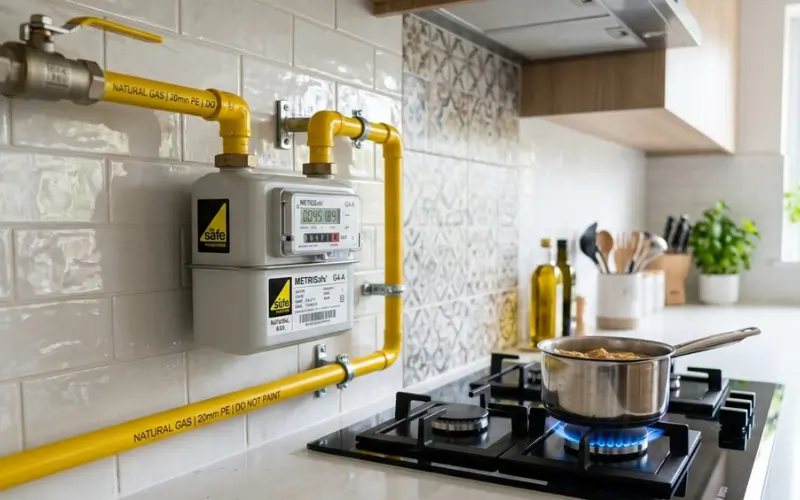
Copper or GI piping gets laid, the meter goes in, a pressure and leak test is run, and once that clears, your supply goes live.
If your building already has a gas riser installed, this whole sequence can wrap up in under two weeks. If your street doesn’t have mains infrastructure yet, you’re looking at a longer timeline tied to network expansion, which I’ll explain how to influence a bit later.
Documents You’ll Actually Need
Keep digital copies of these ready before you start the form. Half the delays I’ve seen reported in customer forums trace back to someone uploading a blurry photo or submitting an ID with an address that doesn’t match their utility bill.
- Identity proof: Aadhaar card (accepted almost everywhere), Passport, Voter ID, or PAN card
- Address proof: Recent electricity bill, water bill, or house tax receipt
- Ownership proof (for owners): Sale deed or the latest property tax receipt
- Tenancy proof (for renters): Registered or notarized rent agreement plus a signed No Objection Certificate from the landlord
- Passport-size photograph: A recent, clear scan works for online applications
- Existing LPG consumer ID: Only if you plan to surrender or place your LPG connection in safe custody at the same time
One detail almost nobody mentions: keep the name spelling identical across every document. A “Mohd.” on your Aadhaar and “Mohammed” on your electricity bill is a common, entirely avoidable reason applications get bounced back for re-verification.
What a New Gas Pipeline Connection Actually Costs
Costs vary by operator and city, and most guides either skip numbers entirely or give a vague range. Here’s what applicants are actually being charged as of 2026, based on published tariff sheets from major operators.
| CGD Company | City / Region | Approx. Total Charges | Refundable Portion |
|---|---|---|---|
| IGL | Delhi-NCR | ₹7,000 (incl. up to 15m pipe) | ₹7,000 (deposit) |
| Mahanagar Gas (MGL) | Mumbai | ₹6,500 total | ₹5,750 |
| THINK Gas | Punjab, UP, MP, Rajasthan, Bihar | Varies by zone, typically ₹5,000 to ₹8,000 | Deposit portion only |
| Torrent Gas | Pune, Gujarat, Rajasthan | ₹5,000 to ₹7,500 | Deposit portion only |
| Gujarat Gas | Ahmedabad, Surat, Vadodara | ₹5,000 to ₹6,500 | Deposit portion only |
A useful pricing reform kicked in from January 2026: PNGRB collapsed the old three-tier distance-based tariff structure into two zones, and pushed nearly all domestic consumers onto the lower Zone-1 rate. If you’re more than 300 km from a gas source, in states like Punjab, UP, or Rajasthan, you likely saw the steepest per-unit price drops. Worth checking your provider’s revised tariff card before you assume PNG will cost what an old blog post quoted two years ago.
For exact, current pricing on THINK Gas new connection prices in your specific zone, calling their contact number listed on the official site beats relying on any third-party number, since these figures do get revised.
Checking PNG Availability Before You Apply
Don’t fill out a full application blind. Every major operator has a pin-code or address-based availability checker on their site, usually under a “New Connection” or “PNG Availability” tab.
If the tool shows your street as unserved, don’t just close the tab. Register your interest anyway. Operators track demand density by locality, and areas with a cluster of registered interest often get prioritized for the next phase of pipeline extension. I’ve seen this play out directly: a housing society in Indore collected around 25 household applications before formally approaching the local operator, and their block was connected well ahead of neighboring streets that applied individually.
Gas Pipeline Connection for Home vs. Society and Commercial Applications
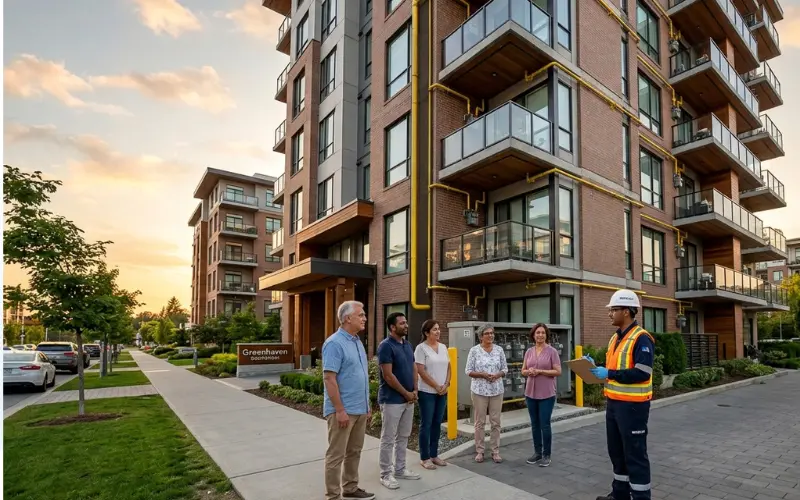
A home application and a society-wide application aren’t handled the same way behind the scenes, and this trips people up.
For a single independent house, you’re the sole point of contact through the entire process, from document submission to inspection scheduling.
For an apartment in a housing society, the building’s management typically needs to grant right-of-way access before individual units can be connected, since the riser pipeline runs through common areas. Under the 2026 order, societies are now required to grant this access within three working days of being formally approached, and last-mile unit connections should follow within 48 hours where it’s technically feasible. If your RWA is dragging its feet, this timeline is worth quoting to them directly.
For commercial kitchens, restaurants, or small industrial units, expect an additional load-assessment step, since commercial burners draw significantly more gas volume than a domestic stove, and the pipeline sizing has to account for that.
Seven Things That Genuinely Speed This Up

Most “tips” articles repeat the same three points. Here’s what actually moves the needle based on how these applications get processed internally.
- Apply on a weekday morning. Portal traffic is lighter and reference numbers get assigned faster than during evening peak hours or weekends.
- Decide your meter location before the inspection, not during it. Technicians move faster when they’re not waiting on you to figure out where the meter should go on the spot.
- Request stove conversion at the time of application, not after. LPG burners use a different nozzle diameter than PNG. Flagging this upfront means the technician arrives with the right parts instead of scheduling a second visit.
- Answer the inspection call, even if it’s from an unknown number. A missed pre-inspection call routinely pushes the appointment back by a week in busy cities.
- Clear physical access before the visit. Balcony clutter, locked utility shafts, or a blocked kitchen wall are small things that cause real delays.
- Check if your society already has a pending bulk application. Piggybacking on an existing group request can genuinely cut your individual wait time in half.
- Save your reference number and follow up proactively after five working days if you haven’t heard back, rather than waiting indefinitely.
What to Do When Something Goes Wrong
This is the part most guides skip entirely, and it’s usually where people get stuck for weeks.
Your application sits with no update for over 20 days
Under the 2026 order, CGD companies operate under fixed approval timelines. File a complaint through PNGRB’s online grievance portal, or contact your operator’s nodal officer directly. Most operators list this contact on their FAQ page.
Your landlord won’t sign the NOC
Explain that the mandatory transition rules apply to the property regardless of who holds the LPG connection. If they remain unresponsive, a written request citing the 2026 order sometimes moves things faster than a phone call. Legal consultation is worth it if a lease renewal is coming up anyway.
Your area shows as “not covered” on the availability checker
Register interest anyway, and separately ask your RWA to file a written bulk enquiry. A documented, collective request carries more weight with the operator’s planning team than scattered individual sign-ups.
You received an LPG discontinuation notice but your street genuinely has no pipeline yet
Respond in writing within the notice window and explain the infrastructure gap. Operators are required to issue a technical infeasibility NOC in that scenario, which keeps your LPG supply active.
How Can I Get a New Gas Pipeline Connection If I’m Relocating?
This scenario deserves its own answer because it’s different from a fresh application. If you’re moving out, request disconnection from your current provider, and your security deposit gets adjusted or refunded, typically within a billing cycle. At the new address, you start the process again from scratch, including a fresh availability check, since your old connection doesn’t transfer.
If both your old and new addresses fall under the same CGD operator, some companies offer a slightly faster “connection transfer” track instead of a full new application. It’s worth asking your provider’s customer care directly, since this option isn’t always advertised on the website.
Pre-Installation Checklist
Print this or save it before your application goes in.
- All ID and address documents scanned clearly, names matching exactly
- Landlord NOC signed and notarized, if renting
- Meter location decided in advance
- Kitchen area cleared for technician access
- Stove conversion requested at application stage
- Phone number active and reachable for inspection calls
- Society right-of-way approval confirmed, if applicable
- Old LPG consumer ID noted, if surrendering simultaneously
Final Thoughts
Getting a new gas pipeline connection isn’t complicated once you know which documents to prepare and which steps actually cause delays. Most of the friction people run into comes down to blurry paperwork, an unanswered inspection call, or simply not knowing that group applications move faster than solo ones. Handle those three things well, and you’ll likely have gas flowing to your kitchen within a few weeks rather than a few months.
FAQs
Q: How can I get a new gas pipeline connection if I don’t know which company serves my area?
A: Visit pngrb.gov.in and use the entity search tool by state or district. Each geographical area in India has exactly one authorized CGD operator, so you can’t shop around between providers.
Q: Can a tenant apply for a gas pipeline connection without the landlord present?
A: Yes, but you’ll need a registered or notarized rental agreement plus a signed NOC from the landlord. Verbal permission isn’t accepted by any major operator.
Q: What happens to my existing LPG connection once PNG is installed?
A: You can either surrender it for a refund of your cylinder deposit, or place it in “safe custody” with your distributor, which keeps it inactive without cancelling it outright. Under the 2026 rules, active refills stop once you have PNG in covered areas.
Q: Is PNG actually cheaper than LPG cylinders?
A: Generally yes, since billing is usage-based rather than per-cylinder, and the January 2026 tariff reform lowered rates further in many zones, especially for households located far from the gas source.
Q: How do I check PNG availability at my exact address before applying?
A: Every major operator’s website has a pin code or address-based checker under their “New Connection” section. If your address shows as unserved, register your interest anyway rather than skipping the step.
Q: Can I speed up installation if my whole society applies together?
A: Yes, and this is genuinely one of the most effective tactics. Bulk applications get prioritized in operator planning because they represent guaranteed demand density in one location.
Q: What if the technician says my kitchen isn’t safe for a meter installation?
A: They’ll usually suggest an alternative meter location, often just outside the kitchen wall or in a utility area, rather than rejecting the application outright. Ventilation and clearance from electrical points are the two most common flags.
Q: Does getting a PNG connection affect my home insurance?
A: It can. A pipeline is a permanent fixed installation, unlike a removable LPG cylinder, so it’s worth confirming your home insurance policy covers fire and explosion-related damage at your current sum insured before activation.
Final Thoughts
So, how can I get a new gas pipeline connection without the process dragging on for months? Check availability first, keep your documents clean and consistent, and don’t wait until an LPG notice lands in your inbox to start. Most of the friction people run into comes down to blurry paperwork, an unanswered inspection call, or simply not knowing that group applications move faster than solo ones. Sort those three things out early, and you’ll likely have gas flowing to your kitchen within a few weeks rather than a few months.
